Join us for the 35th anniversary of IDIAP! We will celebrate with an open day where we will showcase our research. The HCHAI group will be present with a poster about AI, Social Media, and Health. View more information here.
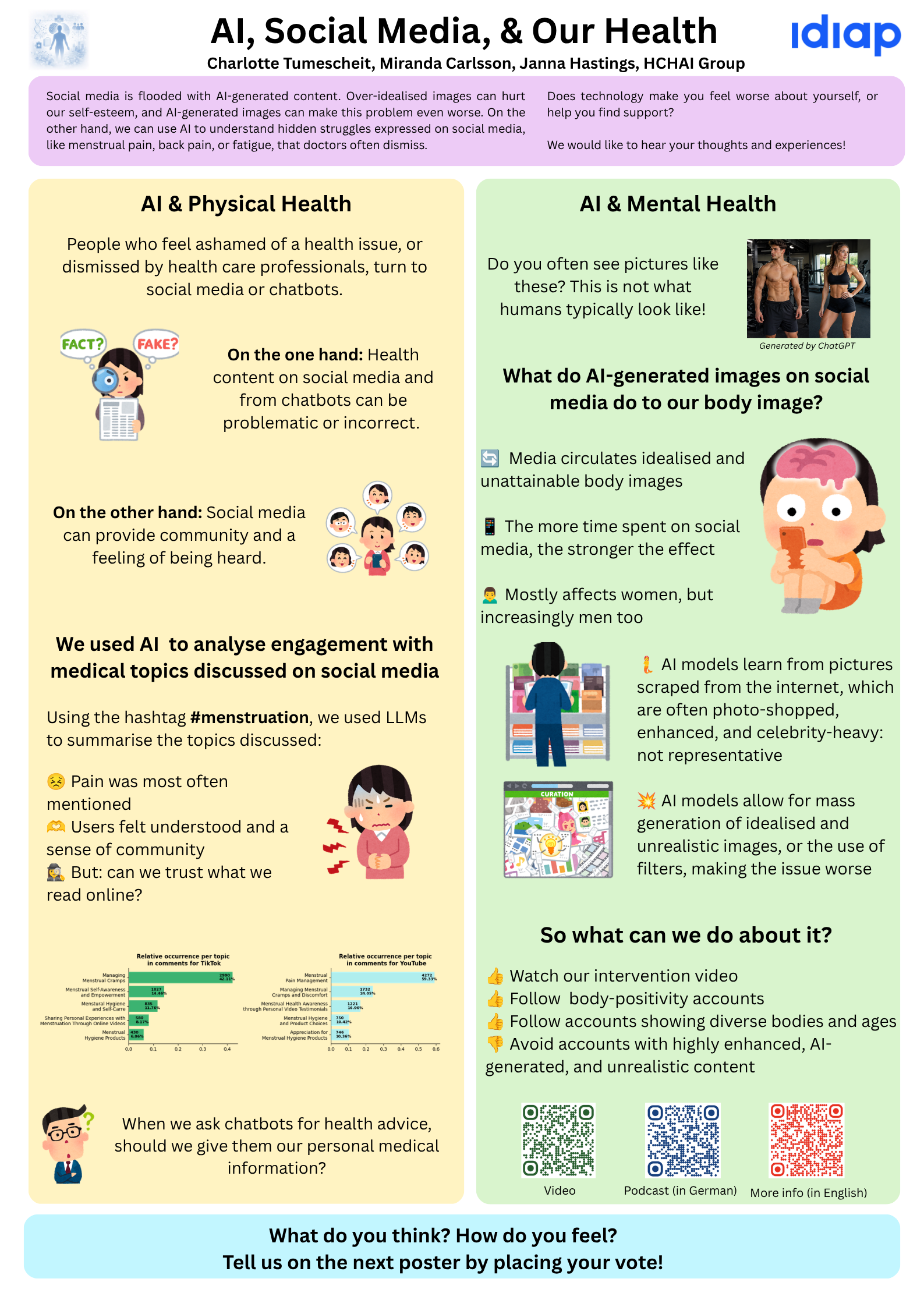
Our poster (English version, French version) explores two aspects of AI & health: the consequences of AI-generated pictures for our body image and the use of social media and AI to explore physical health issues:
The AI & Physical Health part of our poster is largely based on our project SocialMediAI. We are using LLMs to understand how users online interact with health content such as menstruation content. Our most relevant paper can be accessed here.
The AI & Mental Health aspect of our poster is largely based on our UnRealBody project, where we created a video intervention to inform young people about the dangers of over-idealised AI-generated images online. The video can be found here, a podcast (in German) about the project can be found here. The publication will follow soon, so stay tuned!
2025
-
Large Language Models Reveal Menstruation Experiences and Needs on Social Media
Charlotte Tumescheit, Davinny Sou, Marcia Nißen, Tobias Kowatsch, and Janna Hastings
Studies in Health Technology and Informatics, 2025
The gender knowledge gap in medicine, particularly regarding menstruation and disorders such as endometriosis, often results in delayed diagnoses and inadequate care. Many menstruating individuals report dismissal of debilitating symptoms, driving them to seek information and support on online platforms such as TikTok and YouTube. This study leverages social media to identify key topics reflecting lived experiences and needs to bridge this knowledge gap. Using a novel pipeline, we analysed video comments using BERTopic and the Llama 3.1 model. Key topics, including emotional support, educational guidance, and community validation, were consistent with prior research. This study underscores the potential of social media and large language models to inform inclusive menstrual health research, revealing unique insights regarding the menstruation experiences and needs of underrepresented and historically overlooked individuals such as those with irregular cycles.
